
Archives For author

What a pun, eh? This blog is about fonts. To begin, you can ask me what was the hardest thing about redoing all the books, not that you think the effort was worthwhile, but you can still ask.

Go on, ask.

I didn’t hear you.

Say it: What was the hardest thing about redoing all the books, Joe?

Ah, well, since you ask, it was the fonts. In my old-style books, the Hebrew font originated with Digifonts, and that I converted and adjusted with FontLab’s TypeTool (to make scalable .ttf files). Typing was left-to-right, so all the Hebrew was typed bacjwards, though this isn’t really difficult or much less “natural” than typing in any other direction. The Hebrew font was a nice font, a bit blockish, but nice. However, I didn’t have all the characters, such as the cantillation notes. I couldn’t easily do bold or italics.

So for some years I viewed with yearning the standard Hebrew fonts in Windows.

The problem was, I’d have to retype every Hebrew word, each consonant and each vowel, sometimes two or three vowels for a consonant.

I knew I could do it with a macro, but it took me a couple of years to get my macro working. That’s what took so long. Eventually, I had a macro that could convert the direction of each word in a line and each character in each word, so that I could use any of the fonts Microsoft offered.

This solved a very pesky problem. When typing Hebrew back-to-front, spilling past the end of a line pushes the beginning of a phrase onto the next line. Ooh, embarrassing! Using standard Hebrew fonts typed front-to-back (for Hebrew) eliminates the risk of this happening.

The English translation and transliteration used to use a sans-serif font, just because it was narrower than others; someone pointed out that it’s easier to read unfamiliar words such as transliterated words when the font has serifs, so I made that switch too. That didn’t involve any retyping.

I also made sure that the transliteration column is always the same width. The Hebrew and translation columns can grow and shrink as necessary to get the best phrasing on a line, but the transliteration is always the same width. This was surprisingly difficult to achieve, but eventually I found the macro commands to make this happen pretty reliably.

So I owe a lot of thanks to Microsoft and to Word, even though Word can be mighty frustrating. Once you know something that really works in Word, you can do it again and again, for hundreds of pages.

I’m glad you asked. If you didn’t enjoy the answer, you could have stopped reading, so don’t blame me for boring you.

You can stop pretending. I know you don’t really care. But I’ll tell you anyway.

I’m closing in on a long-time goal.

I have the proof for the first of three books that will cover Jewish prayer for Shabbat (one book), festivals (another book) and weekdays (a third book). I’d like to think that, with the Rosh Hashanah and Yom Kippur books, this completes the cycle of Jewish prayer, all transliterated, all non-sexist, all egalitarian-friendly. All vegan and recyclable.

The books are pretty complete, with a lot of material that other books don’t bother to translate–though I know there’s always another obscure medieval acrostic or another prayer for long-gone Jewish leaders in Babylonia that one could revive because it’s traditional.

It’s all transliterated, side-by-side with the Hebrew and the translation.

It all follows the new standards: tell the congregation what to do (when and how to sit, stand, or respond); show people when prayers are quotations from Torah or from other parts of Hebrew scripture.

The fonts are more legible and more precise, too, with thanks to Microsoft for having made Unicode (fonts with every character in every language’s alphabet) part of their operating system for many years.

It’s going to be a big change. I’m planning that the Friday night and Shabbat morning books will be special orders only; the single-copy books will be the “complete” ones; and since they’ll be 300-450 pages, they’ll be hardbacks. They’ll cost more, but they’ll be worth more.

I showed someone the proof; how does it look? “It looks like all your other books.” I’m not sure whether to be disappointed. I want the page to help people as much as is possible in black and white, so I don’t want the changes to be jarring, but I hope they’ll be effective.

So that’s what I’ve been doing. I’m working on one of the final details, the poems we use to call up the honorees for Simchat Torah, but I thought that anyone who actually reads my blog might be interested in what’s forthcoming from the Singlish Publication Society, where we’re as miserable and guilt-ridden as we ought to be!


When I translate the Torah, I’ll translate the names. Not to do so is a cop-out, in my opiniated opinion.

Moses will be Drew, because Pharaoh’s daughter drew him out of the water.

Tziporah will be Birdie.

I don’t have it all worked out yet–don’t rush me.

Abram–אב רם/Av Ram–will be Big Daddy, like the guy who gave his name to the Greek restaurant chain.

I’ve been giving a lot of thought to Abraham–אברהם/Avraham–although we’re way past his stories in the Torah reading, and I think I finally got it. God says he gets the name because he’s going to be father of loads of peoples, אב המון גוים/Av hamon goyim. Don’t take my word for it, look for yourself, in Genesis 17. But the Hebrew name Avraham doesn’t have much to do with Av Hamon Goyim. Where’s the R (resh) in “Av Hamon Goyim,” eh? Where are the G (gimel) and N (nun) in “Avraham”?

At this point, I invite my readers of delicate sensibility to stop reading. I can’t tell you why; it’s not appropriate for you even to think of such things.

Okay, adult readers. What do we know about Abraham? He had a tent with no sides, he ruined  his Daddy’s merchandise? No, that’s midrash and not in the Torah. What’s in the Torah is that he trimmed his pecker, to put it bluntly.

You can try and try to make “Father”-of-something out of  “Av-raham,” but your answer will always fall short. You have to break the whole name into two words, but make the break at a different point. The result is אבר הם, Ever Ham.

In English, we have lots of words for the male organ or membrum virile or penis or pecker or wiener or whatever else you call it.

Hebrew has a rich list, too, but one of the words used is the same word used for a limb: אבר, the first three letters of Abraham’s name. The last two letters, הם/Ham, come from the root המם (Hamam), to confuse or stupefy, as in Ex. 14:24: The Egyptian host was numbed with astonishment when God glanced at them.

Now the name makes sense. Abraham is Ever-Ham, the numb limb. He’s going to breed so many babies that his you-know-what will get numb. His name after he earns God’s promise of future favors is Stupefied Male Organ.

For simplicity in translation, we’ll call him Stupid Prick.

Never mind the idols and the tent, what we really  know about Abraham is that he’s slow to listen to his wife (Gen 21:12), and any man who suffers the same hesitancy deserves the name we can finally give Abraham.

I’m glad we’ve got that sorted out.

People sometimes tell me I should have pictures on my blog.

I’m glad we’ve got that sorted out, too.


It’s always tempting to think that numbers have meaning. Oh, those odd coincidences of Gematria, where the numerical value of one word equals another. Then there are all the 40s in the Torah–the time Moses spent on the mountain, the years of wandering in the wilderness (38, really, but who’s counting?), the days and nights of rain for Noah’s flood.

What about the 603,550 people counted in the wilderness. These were the males 20 and older who had to contribute a half-shekel of silver (Ex. 30:14). It’s not the same as the population: we don’t know how many younger males went uncounted, nor the women, and the Levites were in a separate count. But somehow this group seems to represent the whole people.

In the Sedrah of Pekudey we read that all the silver they contributed was the exact amount needed for the Mishkan, the portable sanctuary (Ex. 38:35). This could suggest that every person’s contribution was essential, that we all have a part to play in the service of God and the mission of the Jewish people.

603,550 is a curious number. The tribe-by-tribe details are in Numbers 1 and again in Numbers 26–different tribal totals, but the overall total is the same. Torah math is just like ours.

But the recursive digit-sum of that number is–well, add 6+3+5+5 to get 19, add 1+9 to get 10, and add 1+0 to get 1–isn’t it a bit of a surprise that the number is 1.

If I were a commentator I might say this isn’t a coincidence. The number that represents the Israelite community boils down to 1.

Maybe this means something. Maybe there are 603,549 incorrect opinions held by my fellow Jews, but we all agree that Yom Kippur is a long day.

By the way, 613 also boils down to 1: as Hillel told the fellow who wanted an express conversion, all the rules in the Torah boil down to one.

When we travel and arrive in an airport in the morning, I look for a place for my daily devotions. Many airports have a place, often called a Meditation Room (that’s the name we gave to our prayer rooms in various buildings at Ford Motor Company, and someone told us it was a whole lot better than praying in her car in the parking lot).

We returned from Israel to Detroit via Amsterdam, arriving at a good time for morning prayer. The Amsterdam meditation room is easy to find, and it’s an attractive space. I was surprised to see so many people of different faiths and philosophies in the room, and I was surprised and pleased to find I wasn’t the only person laying tefillin.

In fact, an Israeli man leaned over to ask me which way was East.

I pulled up the compass app on my iPhone and gave what I hoped was a good answer. East, in case you ever need to know, is facing the door.

I looked up after a while and saw a man on his prayer mat, facing East like me.

It’s easy to forget how close are Jews and Muslims. We pray in the same direction. We believe in one God, so (logic tells me) we pray to the same God, since there’s only one. We ascribe all power and glory, majesty and might, to God.

Richard Burton, the great Victorian adventurer, observed: “In religions as a rule the minimum of difference breeds the maximum of disputation, dislike and disgust.”

But today’s divisions may fade with time, and perhaps one day we’ll become united as we send our prayers in the same direction, toward the open door of the Amsterdam Schiphol Airport Meditation Room.

“These many, then, shall die. Their names are pricked,” says Anthony (Julius Caesar, 4.1.1), as he and his colleagues decide who might threaten their power and must therefore be eliminated. Presumably they had a list of all Rome’s upper-crust and made a hole by the name of the doomed.

Funny thing, this phrase is used in this week’s Torah reading: the list of prominent census checkers (Num. 1:17) are “those who are pricked in name / אֲשֶׁר נִקְּבוּ בְּשֵׁמוֹת / asher nikvu beshemot.” If there’s a common meaning to the idiom as used by Shakespearean Romans and wandering Hebrews, perhaps it means that the person is marked for something, either good or bad.

Prick or pierce: the root is קב. Rashi uses a form of this root to explain that people used to oil their shields so that arrows and spears would slip right off instead of “piercing” them (note to Lev. 26:11).

The root may be related to נְקֵבָה, “feminine,” and נֶקֶב, “opening.” After all, what is a Hebrew letter nun but a nullifier that turns active verbs into passive! (A single Hebrew three-letter root may have more than one unrelated meaning, but it’s hard to resist the temptation to find a connection.)

The root קב seems to appear in Lev. 24:11, the story of the “blasphemer”: “And he pierced, the son of the Israelite woman, the Name / וַיִּקֹּב בֶּן־הָאִשָּׁה הַיִּשְׂרְאֵלִית אֶת־הַשֵּׁם / vayikov ben ha’ishah haYisra’elit et haShem.” This poor fellow did something shocking and nobody knew what to do. They took him to Moses, Moses had to get orders from on high, and then this fellow was executed, one of only two people in the Torah to suffer the death penalty.

What did he do? Perhaps “piercing the Name” means he did something to diminish God’s reputation (“puncturing” the “name”). Bil’am is engaged to curse the Israelites, and he uses the same root when he explains to his employer that this just can’t be done: “What shall I curse/pierce that God has not cursed/pierced / מָה אֶקֹּב לֹא קַבֹּה אֵל / mah ekov lo kabo El” (Num. 23:8).

Or perhaps the “blasphemer” did something else. In a patriarchal society, one’s identity comes from one’s father. The Israelites camp was organized by tribes, and your tribe was inherited from your father. This poor fellow who was executed didn’t have an Israelite father. His Dad was an Egyptian (Lev. 24:10), so where was he to pitch his tent? (Rashi explains that this was his problem.) His Mom’s tribe wouldn’t want him, because they might then have to share part of their promised land with him, too. So he was an outcast, trying to find his place in the Israelite community.

Like all of us, I suppose.

Maybe his very existence called into question the method of tribal organization and land allocation. Maybe when he “pierced the name” it wasn’t God’s name he undermined but the system of social identity, so-and-so the son of his father. And nobody could cope with that. So they offed him.

His Mom was “Peace-girl the daughter of Word-guy of the tribe of Judge-man” (שְׁלֹמִית בַּת־דִּבְרִי לְמַטֵּה־דָן), and maybe this is a comment on the irony of the whole episode: sometimes you have to shut up for the sake of peace, because if you make trouble the community will impose some kind of justice, and you won’t like the result.

Back to Anthony: when a dictator takes over, the first order of business is to eliminate the opposition!

We spent a few days at Shaker Village in Pleasant Hill, Kentucky. Ah, the Shakers. Beauty in simplicity, like the superb craftsmanship of their furniture. A Shaker chair is lightweight and sturdy and upright, like a well-lived life. True, it’s a little rigid and uncomfortable; even a Shaker rocker cuts off circulation after an hour or two, but its clean lines and practicality are something to aspire to. You can even hang it out of the way on pegs installed around the wall.

But the Shakers are almost gone. Their communities were once a retreat from the dangerous world, with secure work and food and education in a caring community; today, Americans seem to prefer the pioneering thrill of an urban jungle or suburban wasteland. Is it a tragedy that the Shakers, or any religious community, should live only in a theme park dedicated to their memory?

A politician’s job is to get re-elected; an institution’s mission is to ensure its continuation. Can we seek no higher purpose than to perpetuate the status quo even if we sincerely wish to change it? Surely, if an institutionhas a true mission, its purpose is to make itself obsolete, irrelevant, unnecessary–and then to disappear.

I’m not keen on disappearing.

Every Jewish service ends with a quotation from Zechariah (14:9): “On that day will God be one.” What if that day arrives and people everywhere acknowledge the unity of God? If Judaism were to accomplish its mission to become a “light to the nations” (Isaiah 49:6), would anyone need Judaism?

Shaker dry stone wall

A dry stone wall, Shaker Village at Pleasant Hill.

There’s a story about a traveler who comes to a little town and sees a man sitting at the town gate. The traveler approaches, and the man seems to have no other business than to watch the world pass by. “Shalom aleichem,” says the traveler. “Aleichem shalom,” responds the man. “Vus macht a Yid?” says the traveler, a Yiddish combination of How’s it going and What are you doing. “You want to know what I’m doing?” says the man, “I’ll tell you. The community hires me to sit here every day and watch, to see if the Messiah comes. It’s not a bad job: it doesn’t pay all that well, but it’s steady work.”

Many of us are pretty sure that the world for which we pray will never arrive. If our prayers were to come true, could we handle success?

The Shakers are almost gone, but perhaps they achieved their mission. They created their own–as they sometimes saw it–heaven on earth. Their example shows that life need not be endless struggle, that a community dedicated to simple living can find security, satisfaction and beauty in work and worship.  Celibacy and rigid uprightness are not for everyone, but the

Shaker model has been adapted for other places and times and has much to teach humans everywhere. If these models for living should pass, let’s study their achievements and celebrate their success as much as we mourn their passing.

Hmm. Went to see The Book of Mormon. Very funny and lively, but it gave me something to think about, too. The faith that takes root in a community must address that community’s problems–in the show, AIDS and child abduction. Of course (we learned in the show) salvation is metaphorical, not to be taken literally.

Much of today’s Judaism developed from the ashes of the Temple; we implore God to rebuild it, we lovingly (well, some of us) recall the details of the Temple service, and though we sort of think prayer is a substitute, we still seem to feel we’re missing something.

Some people look for a literal restoration of the Temple and all it entails, much of which seems unsavory and far from inspiring by today’s standards, but perhaps today’s standards are degenerate. Others think we should stop praying for the Temple; we don’t want it. And still others think the Temple and all it represents is a metaphor for an ideal relationship with God and fellow human beings.

Perhaps we know in our hearts that the Temple for whose restoration we pray is a perfect ideal that never existed in practice, nor could it exist in an imperfect world.

And perhaps this is a common feature of many a religion. They lovingly recall a past that’s idealized and retell a story that seems historically questionable but that reflects problems that once plagued believers. The narrative may be part fantasy, but it can still inspire people to improve themselves and their world, and the metaphor has real power for good. That’s what The Book of Mormon helped me to see.

Still, I felt awkward seeing the show and laughing at its  jokes. Did I betray my friends, those members of the LDS church whom I know and cherish?

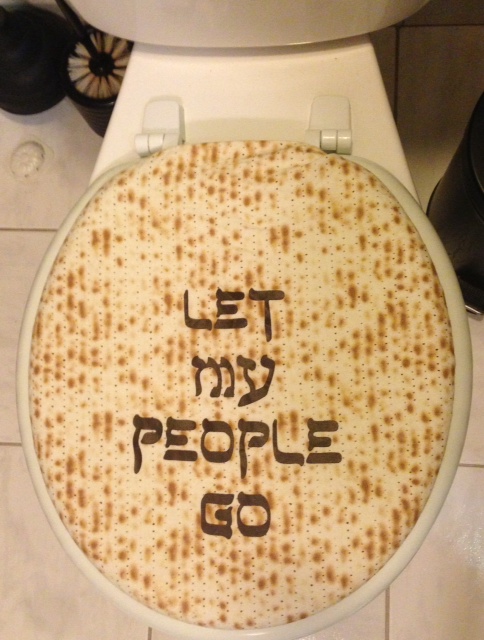
Moses told Pharaoh, “Let my people go,” and after a lot of misery Pharaoh did just that. So the Children of Israel ate manna for 40 years. They ate quail, too, and sometimes–especially the priests–they ate the meat of sacrifices. But their diet (such is our impression) was mostly manna. Eventually they complained about this manna, this “insubstantial food” (Num. 21:5). How was it “insubstantial”? Rashi explains that it was completely absorbed, so there was no — um — waste.

Many children were born on the journey and presumably never learned a useful, perhaps essential, cultural skill.

When the Children of Israel got to their land, the manna stopped (Joshua 5:12), and they ate food from their new land.

After 40 years, they discovered new meaning in Moses’ old command.

photo(3)

At the end of the book of Genesis, Joseph reassures his brothers that their evil action–selling him down to Egypt–was all part of God’s plan (See 45:5 and 50:20); they need not worry that he’ll take revenge.

I like to think that Genesis teaches us how to read the rest of the Torah. God becomes more remote at the stories unfold. At first, God is part of people’s social life, talking to Adam and Eve; then God appears in dreams, to Abraham and others; then God sends messengers (some say angels) to Hagar and others. God sends dreams to Joseph that predict the future. But Joseph understands something new, that God appears in history, too. If you understand your own story, you can see divine guidance in your life–even in the suffering you endure.

This prepares us to see God’s intervention in national history in Exodus and the remaining books of the Torah.

But how does Joseph know that God is behind his story? It’s hard to tell if something that happens is the divine hand pushing the buttons. However, I may have seen it happening on Tuesday, though I didn’t realize it at first.

We were in La Guardia airport, waiting for our 4:45 p.m. flight back to Detroit. Across from us sat a young man with a bright red yarmulkah, purple jacket, purple check shirt, and a grey wool coat and the usual frummster fedora hat. He looked like a nice young man and not too frumm for conversation. He said he was going back to Miami, to Lubavitch yeshivah, ready for smichah, not so that he could become a congregational or community rabbi, but so that he’d have the deep knowledge of Shabbat and Kashrut you’d need in any household.

He was on standby and had already missed a couple of flights.

He’d arrived at four in the morning. Oy! And he had missed his original flight because his driver got lost.

Lost on the way to the airport? Impossible.

Unless … unless … it’s gotta be more than a coincidence. Yup, it’s the Hand of God. If only we open the eyes of our soul (not that a soul has eyes, nor that we have one, nor that such a thing exists) we’ll see that the Red Yarmulkah Man is about to undergo a life-changing experience.

I wish I’d told him to keep an eye out for his besherrt, his destined bride (I’m a yenta, so whenever I see a young person I think about weddings). Lickety-split, he’ll be married, driving his wife to distraction by constantly interfering in the kitchen with kashrut questions (“My dear,  do you know what power magnifying glass do we need in order to check the asparagus for bugs?”). Otherwise, they’ll be happy as can be and blessed with eight children, and he’ll have an actual job with an income. May they be happy as clams. Oops, happy as something kosher … happy as potatoes or carrots.

Watch out, reader. Maybe God is sending you a message right now! I hope it portends happiness.