
Archives for category: Jewish Thoughts

A wise scholar once observed that the Talmud lacks a laugh track. You can’t tell when the Sages were joking.

I thought this applied to the incantation for the “kappa,” the poisonously acrid sap of ancient lettuce, which the Sages used as bitter herb for their seders.

Rabbi Chananel said it was a poisonous bug that lived in lettuce (since it never swarmed on the ground, it might be kosher).

The Talmud (Pesachim 116a) lists some antidotes, including an incantation: “Kappa, kappa, I know all about you and your seven daughters and eight daughters-in-law.”

Ha, ha, I thought; I can almost hear the hoary laughter of Sages slapping each other on the back with raucous laughter as they thought of the superstitious multitudes who’d try talking to their pain.

But we have a friend who suffers from shingles pain–she had shingles some years ago, and the pain returned, but the doctors could find no physical symptoms, so they suggested it’s in her mind. (Of course, all the reality we experience is inside our heads.) She found some relief with the Curable app, which prescribes activities including talking to the pain. Talk to the pain? Do I hear the laugh track?

Or do I hear a different idea. Perhaps if we face up to a problem such as pain, address it as a real entity and don’t try to ignore it, we can deal with it better. Tell the kappa you know it’s there, and what’s more, you know about its personal life and its trials as a parent and parent-in-law.

Early this morning, several of us clustered outside shul waiting (as we often do) for the sticky secured door to open. Repeated attempts to enter the correct electronic code had not been fruitful. I came up, gave the door and good shake to wake it up, and started to say a few sympathetic words. Before I could finish, the door opened.

I choke on maror every year, but this year I have a new strategy: “Maror, with your acrid stench, every year you make me choke, but this year your power I’ll quench for I’ll concede you’re not a joke.”
Perhaps we’ll never know if accusations of conversion scandals are true, so you wouldn’t want to click this link.

But it’s clear that the process of conversion has changed over time, and the Talmud has some interesting information on practices of former times.

We have the stories of prospective converts who were rejected by Shammai but accepted by Hillel (Shabbat 31a). These teachers flourished at the beginning of Rabbinic times; but what about earlier?

Officially, many agree, the first Jews underwent conversion–immersion in a mikveh, circumcision for men, and acceptance of the commandments–at Sinai. By this reasoning, Abraham wasn’t the first Jew. Some say he was the first monotheist, but Adam came earlier. (So who invented polytheism?)

Juan Mejia describes some of the Talmud’s statements on conversion and Maimonides’ interpretation of them in an article that I found fascinating.

But the Talmud has an earlier case of conversion to Judaism: Pharaoh’s daughter. When she went out to “bathe” in the Nile, she didn’t just go for a swim. She immersed herself in the river as a mikveh in order to repudiate her father’s idolatrous practices. That’s why–although her name was “Bitya” she was known as “Yehudiah.” Anyone who repudiates idol worship is pretty close to being Jewish. You can argue about how close, and whether the distance is significant, but I must admit I was surprised to read this (Megillah 13a, with Rashi).

Could someone accept the commandments before they were given? Perhaps, as Einstein said, “the distinction made between past, present and future is  nothing more than a persistent, stubborn illusion” (quoted by Carlo Rovelli, Seven Brief Lessons, 58).

We can also ask who raised Moses, the biological mother who nursed him or the princess who adopted him.

For me there’s one more question: can our prayer communities be more open to people who may not consider themselves Jewish but whose religion, like ours, obliges them to repudiate idolatry?

Have you ever wondered about Adam’s relationship with his children. Abel was dead; Cain was on the move; and Seth was presumably at home. What about his grand-children? Adam lived 930 years, the Torah tells us, long enough to see eight generations of descendants, down to Lamech.

Maybe Methuselah, Lamech’s dad, would sometimes tell his little son, “Hey, Lamech, why don’t go you and visit your great-great-great-(skip a few)-grandfather Adam? Look, you can bring him some shiny apples. Be a good boy.”

Now, you can imagine little Lamech perched on Adam’s wrinkled knee and asking his ancestor about the old days. Can Adam resist regaling him with tales of the Garden of Eden? “Oh, we had it mighty good in there, I can tell you. The weather was perfect, everything grew easily, the produce was delicious.” And then Lamech asks what happened, and Adam tells him, and Lamech slips off his knee and turns to his ancestor with a look of disgust. “You mean, I’d have been on Easy Street but for what you did? You’ve ruined my life! I hate you! I hate you! And I’m never coming back.”

I’ve often wondered why the Torah tells us Adam lived through all those generations: Seth, Enosh, Kenan, Mahalalel, Yered, Enoch, Methuselah and Lamech. I used to think they had close family ties from generation to generation. But if Adam admitted what he did, and the consequences for humanity, I can’t imagine his descendants forgiving him. Maybe he lived out his very long years without a single loving visitor.

After I outgrew my callow youthfulness I stopped laughing at ethnic jokes about Easterners saying Rimo for Limo (except funny ones, of course).

When I learned a bit of Thai, I found that L and R are close, anyway. A Thai man ends a statement with “krap,” but on my tape it sometimes sounded like “klap,” and the difference was minor. Notice what happens to your tongue when you say “bring” and then “bling.”

Some languages make little distinction between o and a, or a and e. At a poorly attended linguistics lecture in college, I learned that the secret to upper-class English is making all vowels sound like the uh in “turn.” Try it; you’ll sound like a chinless wonder.

English vowels and consonants are often barely intelligible, anyway. Does the song promise “there’s a bathroom on the right”?

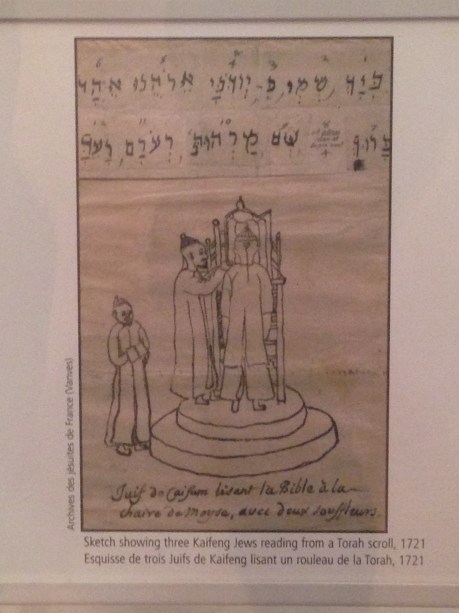
So let’s not laugh at other people’s pronunciation as we look at a feature of the picture below. The Royal Ontario Museum in Toronto displays some items relating to the Jews of Kaifeng, China. In the early 1700s, a presumably Christian observer sketched Torah reading in the Kaifeng synagogue, and someone wrote part of the Hebrew of the blessings. The second line looks like it’s intended to be “Baruch shem kevod, malchuto le’olam va’ed.” See the numbers over the words, 7, 8, 9, 10, 11, 12? I presume those numbers are to help a left-to-right reader follow Hebrew right to left.

Now, please don’t snigger as I point out that 10 and 11 look like they use resh instead of a lamed, “mar’chuto re’oram.”

Kaifeng Jews are supposed to have been cut off from the rest of the Jewish community for centuries, during which their knowledge of Hebrew declined, and this could account for non-standard Hebrew spelling. But resh for lamed?

That, I suppose, is the Oriental articulation or Olientar alticuration. And no, it’s not funny, though it’s mighty intriguing.img_2611


You can stop pretending. I know you don’t really care. But I’ll tell you anyway.

I’m closing in on a long-time goal.

I have the proof for the first of three books that will cover Jewish prayer for Shabbat (one book), festivals (another book) and weekdays (a third book). I’d like to think that, with the Rosh Hashanah and Yom Kippur books, this completes the cycle of Jewish prayer, all transliterated, all non-sexist, all egalitarian-friendly. All vegan and recyclable.

The books are pretty complete, with a lot of material that other books don’t bother to translate–though I know there’s always another obscure medieval acrostic or another prayer for long-gone Jewish leaders in Babylonia that one could revive because it’s traditional.

It’s all transliterated, side-by-side with the Hebrew and the translation.

It all follows the new standards: tell the congregation what to do (when and how to sit, stand, or respond); show people when prayers are quotations from Torah or from other parts of Hebrew scripture.

The fonts are more legible and more precise, too, with thanks to Microsoft for having made Unicode (fonts with every character in every language’s alphabet) part of their operating system for many years.

It’s going to be a big change. I’m planning that the Friday night and Shabbat morning books will be special orders only; the single-copy books will be the “complete” ones; and since they’ll be 300-450 pages, they’ll be hardbacks. They’ll cost more, but they’ll be worth more.

I showed someone the proof; how does it look? “It looks like all your other books.” I’m not sure whether to be disappointed. I want the page to help people as much as is possible in black and white, so I don’t want the changes to be jarring, but I hope they’ll be effective.

So that’s what I’ve been doing. I’m working on one of the final details, the poems we use to call up the honorees for Simchat Torah, but I thought that anyone who actually reads my blog might be interested in what’s forthcoming from the Singlish Publication Society, where we’re as miserable and guilt-ridden as we ought to be!


When I translate the Torah, I’ll translate the names. Not to do so is a cop-out, in my opiniated opinion.

Moses will be Drew, because Pharaoh’s daughter drew him out of the water.

Tziporah will be Birdie.

I don’t have it all worked out yet–don’t rush me.

Abram–אב רם/Av Ram–will be Big Daddy, like the guy who gave his name to the Greek restaurant chain.

I’ve been giving a lot of thought to Abraham–אברהם/Avraham–although we’re way past his stories in the Torah reading, and I think I finally got it. God says he gets the name because he’s going to be father of loads of peoples, אב המון גוים/Av hamon goyim. Don’t take my word for it, look for yourself, in Genesis 17. But the Hebrew name Avraham doesn’t have much to do with Av Hamon Goyim. Where’s the R (resh) in “Av Hamon Goyim,” eh? Where are the G (gimel) and N (nun) in “Avraham”?

At this point, I invite my readers of delicate sensibility to stop reading. I can’t tell you why; it’s not appropriate for you even to think of such things.

Okay, adult readers. What do we know about Abraham? He had a tent with no sides, he ruined  his Daddy’s merchandise? No, that’s midrash and not in the Torah. What’s in the Torah is that he trimmed his pecker, to put it bluntly.

You can try and try to make “Father”-of-something out of  “Av-raham,” but your answer will always fall short. You have to break the whole name into two words, but make the break at a different point. The result is אבר הם, Ever Ham.

In English, we have lots of words for the male organ or membrum virile or penis or pecker or wiener or whatever else you call it.

Hebrew has a rich list, too, but one of the words used is the same word used for a limb: אבר, the first three letters of Abraham’s name. The last two letters, הם/Ham, come from the root המם (Hamam), to confuse or stupefy, as in Ex. 14:24: The Egyptian host was numbed with astonishment when God glanced at them.

Now the name makes sense. Abraham is Ever-Ham, the numb limb. He’s going to breed so many babies that his you-know-what will get numb. His name after he earns God’s promise of future favors is Stupefied Male Organ.

For simplicity in translation, we’ll call him Stupid Prick.

Never mind the idols and the tent, what we really  know about Abraham is that he’s slow to listen to his wife (Gen 21:12), and any man who suffers the same hesitancy deserves the name we can finally give Abraham.

I’m glad we’ve got that sorted out.

People sometimes tell me I should have pictures on my blog.

I’m glad we’ve got that sorted out, too.