
After I outgrew my callow youthfulness I stopped laughing at ethnic jokes about Easterners saying Rimo for Limo (except funny ones, of course).
When I learned a bit of Thai, I found that L and R are close, anyway. A Thai man ends a statement with “krap,” but on my tape it sometimes sounded like “klap,” and the difference was minor. Notice what happens to your tongue when you say “bring” and then “bling.”
Some languages make little distinction between o and a, or a and e. At a poorly attended linguistics lecture in college, I learned that the secret to upper-class English is making all vowels sound like the uh in “turn.” Try it; you’ll sound like a chinless wonder.
English vowels and consonants are often barely intelligible, anyway. Does the song promise “there’s a bathroom on the right”?
So let’s not laugh at other people’s pronunciation as we look at a feature of the picture below. The Royal Ontario Museum in Toronto displays some items relating to the Jews of Kaifeng, China. In the early 1700s, a presumably Christian observer sketched Torah reading in the Kaifeng synagogue, and someone wrote part of the Hebrew of the blessings. The second line looks like it’s intended to be “Baruch shem kevod, malchuto le’olam va’ed.” See the numbers over the words, 7, 8, 9, 10, 11, 12? I presume those numbers are to help a left-to-right reader follow Hebrew right to left.
Now, please don’t snigger as I point out that 10 and 11 look like they use resh instead of a lamed, “mar’chuto re’oram.”
Kaifeng Jews are supposed to have been cut off from the rest of the Jewish community for centuries, during which their knowledge of Hebrew declined, and this could account for non-standard Hebrew spelling. But resh for lamed?
That, I suppose, is the Oriental articulation or Olientar alticuration. And no, it’s not funny, though it’s mighty intriguing.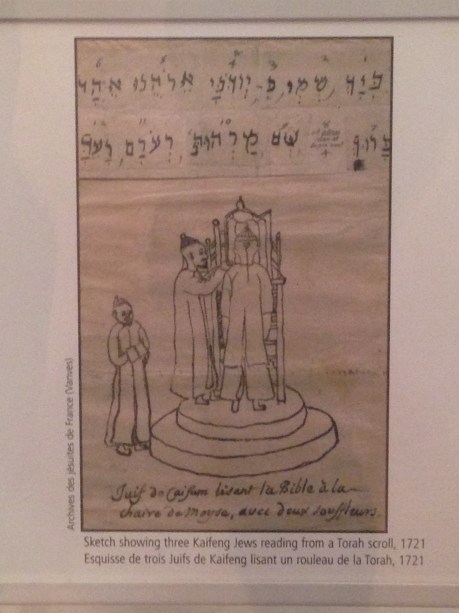
 The Singlish Publication Society